|
|
|
|
|
|
|
7.2
Settled Sewerage in Zambia |
|
|
|
|
|
|
|
|
Settled sewerage was originally developed in the late 1950s by Mr L.J. Vincent, Manager of the then African Housing Board of Northern Rhodesia (now the Zambian National Housing Authority) (G.v.R. Marais, 1995, personal communication). Conventional and sullage aqua-privies did not work well in Northern Rhodesia and so settled sewers were developed to remove the settled wastewater (toilet wastes and sullage) from the aqua-privy tanks. The first such system was installed in 1960 at Kafue, an industrial township 50 km south of Lusaka; the land here, known as the Kafue Flats, is very flat indeed with a fall of only 1 in 2000. The sewers were designed for daily peak velocity of 0.3 m/s, and the pipes were 100 mm minimum diameter laid at a minimum gradient of 1 in 200. They were designed only to flow partially full and not, unlike the more recent North American |
|
|
|
|
|
|
|
|
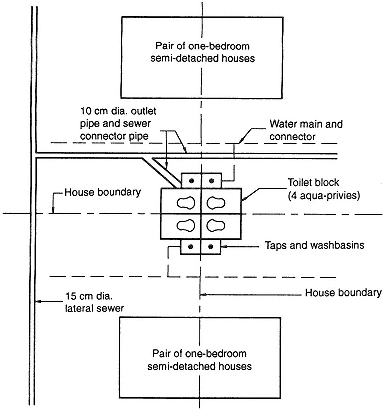
Figure 7.2
Typical sewered aqua-privy block in Chipanda, Matero (Zambia) |
|
|
|
|
|