|
|
|
|
|
|
|
between the high bed shear stresses required to erode the consolidated cohesive deposits found particularly in combined sewers (which in many cases exceeded 800 N/m2), and the relatively lower values that relate to the threshold of motion of freshly deposited sanitary solids. |
|
|
|
|
|
|
|
|
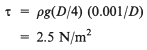
It may be demonstrated (Marriott, 1994) that threshold-ofmotion values reported for recently deposited solids are similar to the average boundary shear stress (t) experienced by a pipe of internal diameter D (mm) laid at a gradient of 1 in D and flowing full: |
|
|
|
|
|
|
|
|
This unit tractive force or boundary shear stress approach has been used in some standards, for example the Metropolitan Water Sewerage and Drainage Board, Sydney (1979), where limiting gradients (S, %) were specified as: |
|
|
|
|
|
|
|
|
where R = hydraulic radius (m). |
|
|
|
|
|
|
|
|
The slope of a pipe flowing full with gradient 1 in D may be seen to lie between these two values, with S = (0.025 / R). The 'deemed to satisfy' criterion from Sewers for Adoption for low flows is a form of this gradient rule, although the average boundary shear stress will be reduced for flows and proportional depths below half full. With respect to low flows, it is worth mentioning that the effective peaking factor from a small number of dwellings is likely to be rather higher than the values traditionally assumed for sewer design. We are here at the interface between building drainage and sewerage. Butler (1991) recorded a mean flow rate of 1.0 litres per second from WC cisterns, in a survey of discharges from domestic appliances. This is over 20 times the peak design flow per dwelling of 0.046 litres per second. There will be some attenuation of short duration discharges, but clearly the peaks inherent in appliance discharges will be beneficial for self-cleansing. Notwithstanding this, the 'deemed to satisfy' low flow criterion is still considered |
|
|
|
|
|